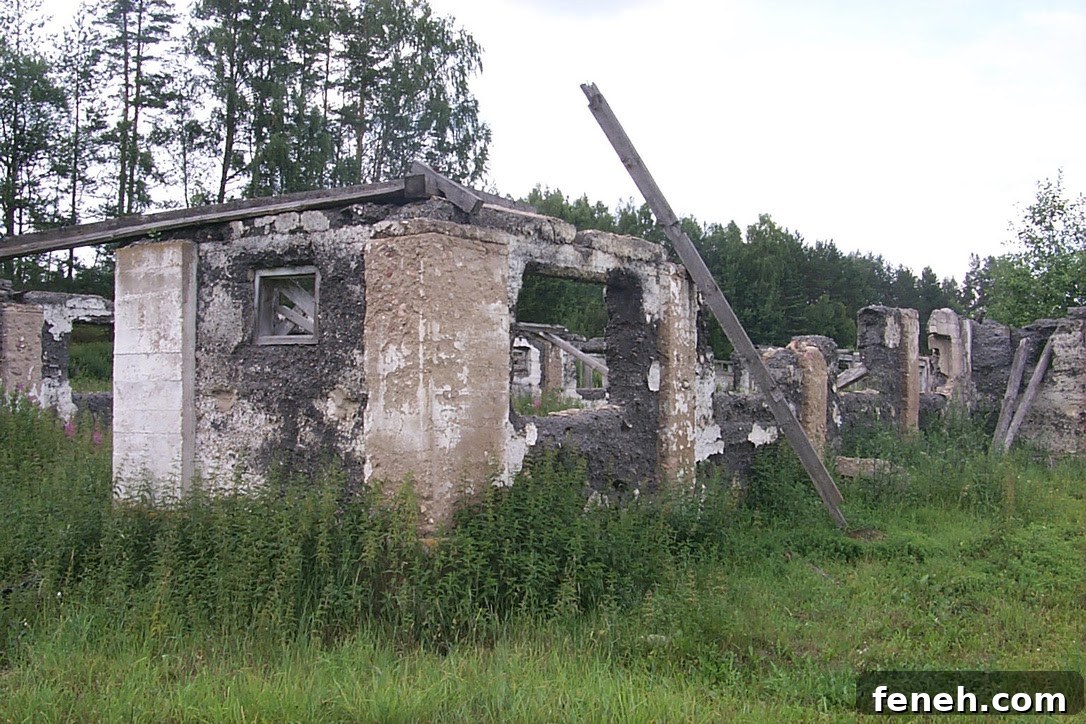
Nestled in the quiet countryside near Labanoras, the ruined buildings of a former collective farm stand as a stark reminder of a transformed past. Once a place of shared labor and communal life, these crumbling structures now speak to the passage of time: weathered walls, collapsed roofs, and overgrown yards that nature is steadily reclaiming. The scene offers a poignant mix of decay and resilience, where the physical traces of a different era remain visible, yet slowly yield to surrounding forests and fields.
Walking among the ruins, visitors notice details that hint at daily life long ago: the remnants of storage rooms and barns, fragments of concrete pathways, and rusted hardware frozen in place. These fragments suggest a rhythm of collective activity—harvesting, processing, and storing food—that once organized the landscape. Today, birds nest where workers once moved, and wild plants push through cracks in the pavement, softening the hard lines of human construction.
The site draws photographers and history enthusiasts alike. For photographers, the interplay of light and shadow on broken masonry and peeling paint creates compelling visuals. For those interested in social history, the farm is a tangible link to a period of centralized agriculture and communal living, providing a place to reflect on how communities and economies evolve over generations.
Local people treat the area with a mixture of nostalgia and practicality. Some remember the farm’s former activity and the social ties it generated; others view the ruins as useful sources of reclaimed materials or as land awaiting new purposes. In recent years, some rural properties nearby have been repurposed for small-scale farming, forestry, or seasonal recreation, demonstrating how the landscape adapts over time.
Ecologically, abandoned agricultural sites often become pockets of biodiversity. The unused fields and neglected buildings create varied habitats for plants, insects, and small mammals. Successional growth—shrubs, young trees, and wildflowers—transforms the open spaces into corridors that connect larger forested areas, supporting wildlife movement and increasing local ecological complexity.
Preserving such places raises questions about heritage, memory, and land use. Should these buildings be stabilized as historical reminders, cleared for new development, or left to natural processes? Each choice carries implications for cultural preservation, ecological value, and community needs. In many rural regions, these decisions are made case by case, often influenced by local resources and priorities.
Ultimately, the ruins of the collective farm near Labanoras offer a quiet, reflective experience. They invite onlookers to consider the lives once lived there, the larger economic and social systems that shaped those lives, and the way landscapes transform when human activity slows or stops. As seasons pass, the site remains a living record—part memory, part ecology—marked by decay but also by the steady work of natural regeneration.